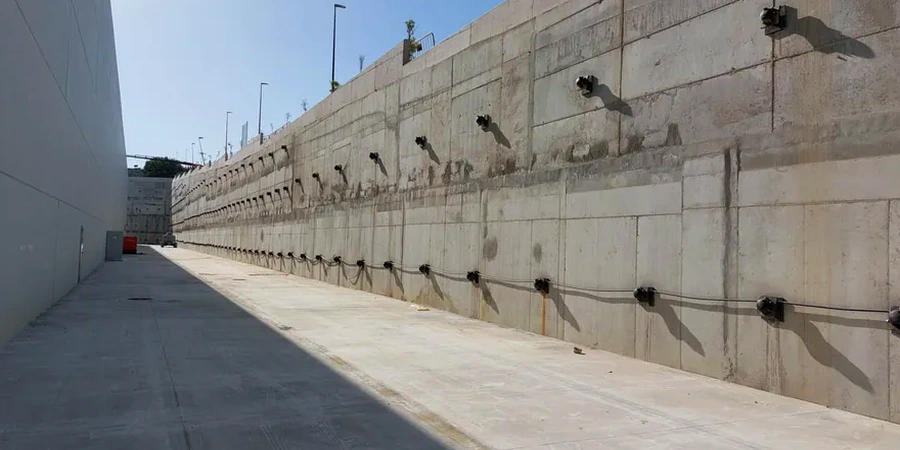
One of the most costly mistakes a contractor can make in Saguenay is treating rock anchors as a one-size-fits-all solution. The city sits within the Saguenay Graben, a seismically active rift valley where the bedrock is extensively fractured and intruded by diabase dykes. A passive anchor bonded in what appears to be competent granite can fail progressively if the grout column crosses an undetected fissure zone, particularly in the steep cuts along Boulevard Talbot or near the Jonquière industrial sector. We routinely see projects where the original design underestimated the required unbonded length because the consultant did not account for the weathered horizon that extends 3 to 6 meters below the surface in the Chicoutimi formation. Our team approaches every anchor design with a site-specific investigation that includes inclined boreholes to map fracture orientation before selecting the bar type and corrosion protection level. The 1988 M5.9 earthquake, centered just 35 km south of the city, is a constant reminder that anchors in this region must resist not only static earth pressures but also cyclic seismic loads that can degrade grout-steel adhesion over time. For deep excavations in the La Baie basin, where marine clays of the Laflamme Sea deposit reach thicknesses of 60 meters, we often integrate slope stability analysis with the anchor layout to ensure the overall cut remains stable during the staged construction sequence.
In the Saguenay Graben, an anchor's reliability is defined not by its steel grade but by the geological intelligence behind its bond zone placement.
Area-specific notes
A 9-meter-high anchored soldier pile wall on Rue Roussel in Chicoutimi began showing distress during excavation when four of the upper-row anchors exceeded the allowable creep rate within 48 hours of stressing. The investigation revealed that the bond zones, specified at 6 meters in length, had been installed in a silty clay layer with undrained shear strength below 30 kPa, which was not identified in the original sparse borehole program. The contractor had to install additional strand anchors at a shallower inclination, incurring a 22-day delay and CA$85,000 in unplanned costs. This scenario repeats itself across Saguenay when the ground investigation does not extend far enough behind the wall face to characterize the bond zone material. Anchors in the rock of the Canadian Shield are equally unforgiving: a single steeply dipping joint set filled with chlorite can reduce the grout-to-rock bond strength by 60% compared to intact anorthosite. The only safeguard is a testing program that includes sacrificial anchor tests to failure on the project site, calibrated to the specific lithology encountered during drilling, and a systematic lift-off test schedule that captures any load redistribution before it compromises the entire anchored system.
Quick answers
What is the typical cost range for anchor design on a retaining wall project in Saguenay?
Anchor design fees in Saguenay typically range from CA$1,570 to CA$4,940, depending on the number of anchor rows, the required corrosion protection class, and the extent of the geotechnical investigation needed to characterize the bond zone material. A project with five or more anchors in fractured rock requiring inclined exploratory drilling will fall toward the upper end of this range.
How does the Saguenay Graben geology affect anchor bond length?
The graben's bedrock is cross-cut by multiple joint sets and diabase dykes that create preferential flow paths for groundwater, which can soften the grout-rock interface over time. Bond lengths must be verified by on-site pull-out tests rather than relying on published ultimate bond stress values, and the fixed anchor should be positioned to avoid known fracture zones mapped during the site investigation.
What corrosion protection level is required for permanent anchors in this region?
Given Saguenay's aggressive groundwater chemistry, with low pH and elevated sulfate concentrations in certain post-glacial deposits, permanent anchors require double corrosion protection as defined by PTI DC-35.1. This includes a corrugated plastic sheath over the tendon bond length, encapsulated anchor heads, and epoxy coating on the bearing plate assembly.
How do you account for seismic loads in anchor design in Saguenay?
The NBCC 2020 prescribes a seismic hazard with a 2% in 50-year probability for the Saguenay region. We apply pseudo-static coefficients (kh) between 0.12 and 0.18, depending on the site class, and combine these with the static earth pressure diagrams. The anchor free length is also checked for the additional dynamic elongation that could occur during a design earthquake event.
What testing confirms that an anchor is performing correctly?
Performance testing involves incremental loading to 133% of the design load with creep measurements at each load step. The acceptance criterion for Saguenay projects is a creep rate below 2.0 mm per logarithmic cycle of time, consistent with PTI recommendations. Additionally, lift-off tests are conducted on at least 10% of production anchors at 7 and 28 days after lock-off to confirm load retention.