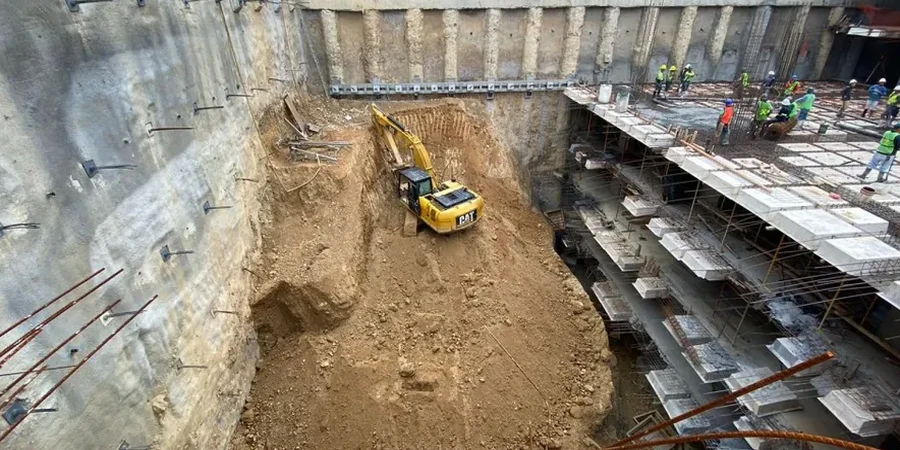
In Saguenay, you hit rock in some spots and twenty meters of sensitive clay in others—sometimes on the same block. The Champlain Sea deposits that blanket much of the region do not respond well to surprises. We see it regularly: a contractor opens a cut, the bottom heaves, and suddenly the shoring is taking load it was never designed for. Proper geotechnical design of deep excavations here means anticipating that behavior before the first bucket comes out of the ground. Whether the project is in downtown Chicoutimi or near the railyards in Jonquière, we run the lab tests and stability checks that keep the walls standing and the adjacent structures intact. For sites where the soil profile changes fast, we often pair the design phase with CPT testing to map the stratigraphy without gaps—essential when you are working next to century-old foundations.
In Saguenay’s Champlain clay, basal heave is not a textbook footnote—it is the first failure mode we check on any cut deeper than 5 meters.
Scope of work
The National Building Code of Canada and CSA A23.3 set the backbone, but in Saguenay we also deal with frost penetration that can reach 2.0 meters in a normal winter. That means temporary excavation support has to survive freeze-thaw cycles that loosen the upper crust and send water where you do not want it. Our design approach starts with a detailed site characterization: we classify the clay sensitivity using Atterberg limits and fall-cone tests, then run consolidated-undrained triaxial tests to get the effective stress parameters right. For cuts deeper than 6 meters in the La Baie sector, where the marine clay is often softer, we model staged excavation sequences and check basal heave explicitly—skipping that step has led to failures elsewhere in the St. Lawrence Lowlands. We specify soldier pile and lagging systems, tied-back walls, or secant piles depending on proximity to neighbors and the depth to bedrock, which in Saguenay can vary from zero at the fjord edges to over 30 meters in the lowlands.
Area-specific notes
Saguenay sits in a moderate seismic zone—the 1988 earthquake was a wake-up call—and the combination of shaking and sensitive clay is the scenario that keeps geotechnical engineers up at night. Liquefaction is not the main concern here; it is strain-softening and flow sliding in the marine silts and clays. A deep excavation that unloads the toe of a slope can trigger progressive failure if the clay sensitivity exceeds 20, and we have mapped values above 50 in parts of the Jonquière borough. Groundwater is the other constant challenge. The water table often sits within 2 meters of the surface, and the stratified silts and sands lenses carry it fast. Without a solid dewatering and monitoring plan—piezometers, inclinometers, and settlement points—the excavation base turns into a soup and the street behind the wall starts to crack. We design for those conditions from day one, not as an afterthought.
Quick answers
How much does a geotechnical design for a deep excavation cost in Saguenay?
For a typical project in the Chicoutimi or Jonquière area, the design package including site investigation, lab testing, and shoring design runs between CA$2,770 and CA$10,320. The spread depends on excavation depth, the number of boreholes, and whether we need to run specialized tests like triaxial on sensitive clay samples.
Why is sensitive clay such a big problem for excavations here?
The Champlain Sea left behind clays with a card-house structure that can lose most of their strength when disturbed. In Saguenay, we have measured sensitivity values above 50 in some deposits. If an excavation unloads the base too fast or vibration from equipment remolds the clay at the toe, the soil can transition from a stiff material to a near-liquid state in minutes—leading to massive ground loss.
What kind of wall systems do you typically design in the Saguenay region?
It depends on the depth and the neighbors. For cuts up to 6 meters in open areas, soldier piles with timber lagging often work. In tight urban lots in Chicoutimi, we lean toward secant pile walls or tied-back soldier piles to limit deflection. Where bedrock is shallow, we design rock-anchored systems; in the deeper clay basins, we use multiple levels of tiebacks or internal bracing.
How long does it take to get from site investigation to final shoring design?
A typical timeline runs four to six weeks. The first two weeks cover drilling, sampling, and installing piezometers. Lab testing on the sensitive clays takes another two weeks because we need to run consolidated-undrained triaxial tests with pore pressure measurement. The remaining time goes to analysis, wall design, and drafting the construction-ready package.