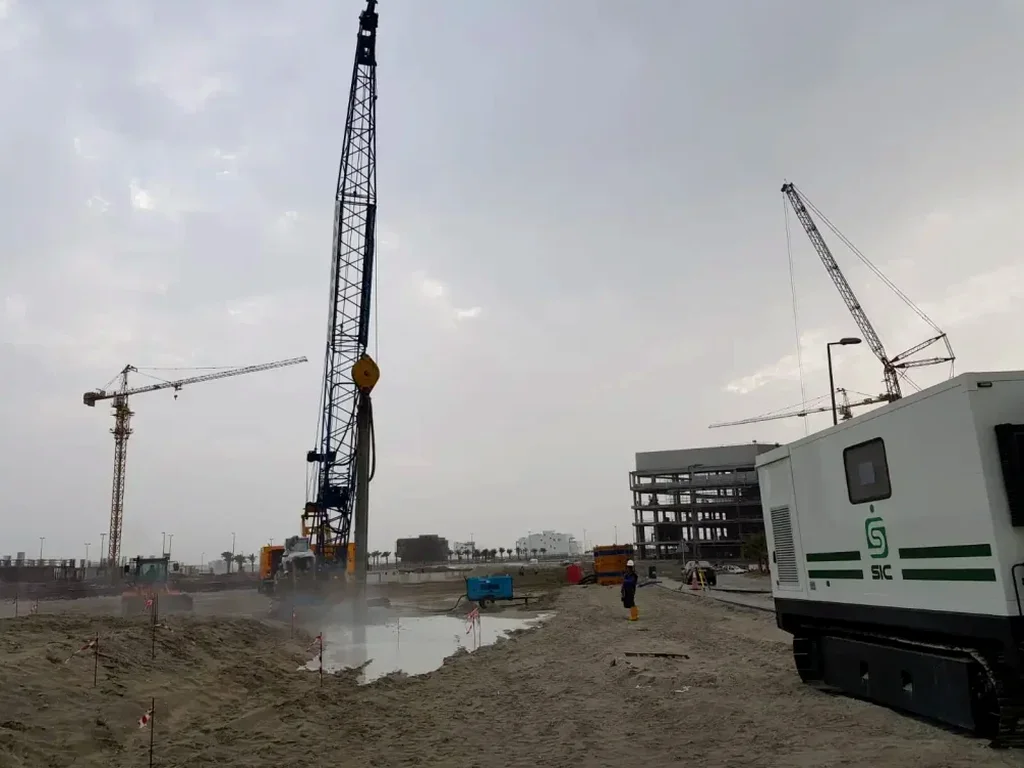
The Saguenay graben presents a unique geotechnical puzzle that standard compaction methods rarely solve. Much of the urban corridor from Jonquière to Chicoutimi sits atop the Laflamme Sea deposits—thick sequences of sensitive silty clay interbedded with loose glaciofluvial sand and silt lenses. When you propose a warehouse slab near the Saguenay River or a roadway embankment crossing old meander scars, you are dealing with liquefiable granular layers that sit beneath a crust of marginally stable clay. Vibrocompaction design in this context is less about generic depth grids and more about targeting those discrete, saturated granular pockets that NBCC 2020 seismic provisions classify as potentially unstable. The Saguenay region, still seismo-tectonically active after the 1988 M5.9 event, demands Improvement that is pre-verified through MASW shear-wave velocity profiling and CPT-based liquefaction screening before any vibro rig moves onto site. Our team correlates the Laflamme sediment stratigraphy with real penetration resistance to avoid treating the entire profile as uniform—something that saves both time and mobilization cost in the Saguenay winter months.
In Saguenay, effective vibrocompaction targets the scattered loose sand lenses inside the Laflamme Sea clay, not the entire soil column uniformly.
Area-specific notes
One recurring pattern we observe in the Chicoutimi and La Baie sectors is the misidentification of the clay crust as a bearing layer, which leads designers to skip deep compaction entirely. The problem is that the underlying loose sand—often only 1 to 2 meters thick—can still trigger cyclic softening during a moderate earthquake, causing differential settlement that fractures slab-on-grade floors and severs buried utilities. Another subtle risk involves the pore pressure buildup in the sensitive clay during prolonged vibration. If the vibroflot dwell time per stage is not reduced when passing through the Champlain Sea equivalent clays, localized remolding can create a softened annulus around the probe that reduces lateral confinement for the sand compaction phase. Saguenay's cold winters add a third variable: frozen ground at the surface forces a pre-drilling step or delays compaction until spring thaw, compressing project schedules. The design must therefore account for seasonal access windows and specify a quality control protocol that includes post-compaction dilatometer testing (DMT) or CPT soundings at 10% of the grid points, per the NBCC geotechnical investigation requirements.
Standards used
ASTM D6066-19 (Standard Practice for Determining the Normalized Penetration Resistance of Sands for Evaluation of Liquefaction Potential), NBCC 2020 (Division B, Part 4 – Seismic Design), CSA A23.3-19 (Design of Concrete Structures, foundation references), ASTM D5778-20 (CPT standard, used for verification)
Quick answers
How much does vibrocompaction design cost for a typical Saguenay commercial lot?
Design and QA/QC verification for a standard commercial lot in the Saguenay region typically ranges from CA$2,290 to CA$6,750, depending on the number of compaction points, depth of the loose sand lenses, and the complexity of the pre-treatment CPT campaign.
Can vibrocompaction be performed in winter on a Saguenay site?
Winter compaction is feasible but requires a pre-drilling rig to break through the frozen crust, which can reach 1.5 to 2 meters in the Saguenay area. The design phase should schedule the QA/QC verification for late spring, once the active layer has fully thawed and pore pressures have stabilized.
What is the minimum thickness of loose sand that justifies vibrocompaction in the Saguenay graben?
Even a continuous loose sand lens as thin as 1.0 to 1.5 meters can warrant compaction if it sits within the critical depth for liquefaction (typically the upper 15 meters) and the structure is in a high seismic importance category. The 1988 Saguenay earthquake demonstrated that thin interbeds can still generate excess pore pressure and cause surface settlement.