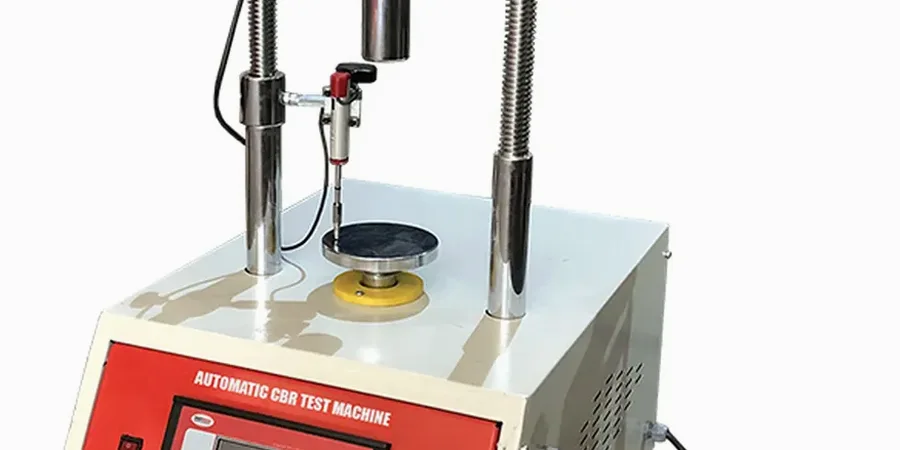
When a pavement design references ASTM D1883, the California Bearing Ratio test becomes the benchmark for subgrade and base course evaluation. In Saguenay, where winter frost can penetrate over two meters into the ground, the soaked CBR value is not just a number on a spec sheet; it is the parameter that dictates whether a road section will survive the spring thaw without rutting and differential heave. Our laboratory processes hundreds of specimens each season, from the granular deposits along the Saguenay River terraces to the sensitive marine clays found in the Jonquière sector. The standard calls for a four-day soaking period under a surcharge load, simulating the worst-case saturation conditions that follow snowmelt, which is exactly what any pavement structure in this region must withstand. For projects where in-situ density control is also required, we often pair the CBR program with in-situ sand cone density testing to verify compaction levels before paving begins.
In Saguenay, a soaked CBR below 3% in the spring is a direct predictor of pavement failure before the first heavy truck passes.
Scope of work
A recent project involved a collector road expansion through a low-lying area near Laterrière, where the native subgrade was a silty clay with natural moisture content above the plastic limit. The designer needed both soaked and unsoaked CBR values to calibrate the pavement thickness according to the AASHTO 1993 design guide. We prepared three identical specimens at modified Proctor energy, and after soaking, the CBR dropped from an average of 22 percent to just 6 percent, a clear signal that a substantial granular capping layer would be required. The load-penetration curve from the CBR press showed a pronounced correction for the initial concave-upward shape, typical of these glaciolacustrine clays. Because the project also involved a structural section with a rigid pavement option, we recommended supplementing the program with
flexible pavement design parameters to optimize the asphalt concrete thickness. Every step, from trimming the specimen with a straightedge to recording the swell percentage after soaking, follows the rigid sequence mandated by ASTM D1883-21. The lab’s triaxial load frame applies the penetration piston at a constant rate of 0.05 inches per minute, with readings taken at defined penetration intervals up to 0.5 inches. The entire process, including moisture content determination and post-test observation of the failure surface, is logged into our LIMS for full traceability.
Quick answers
What is the difference between a soaked and an unsoaked CBR test?
The unsoaked test is run immediately after compaction at the target moisture content. The soaked test submerges the specimen in water for 96 hours under a surcharge load that simulates the weight of the pavement structure, then measures CBR. In Saguenay, the soaked value is almost always the design-governing parameter because of heavy spring saturation from snowmelt.
How much does a laboratory CBR test cost in Saguenay?
A standard three-point CBR test (three specimens compacted at the same energy) typically ranges from CA$190 to CA$330, depending on whether only soaked conditions are required or both soaked and unsoaked values are needed, and on the compactive effort specified.
How many specimens are needed for a CBR test?
ASTM D1883 requires a minimum of three specimens for a single compactive effort, all prepared at the same moisture-density target. If the design requires CBR at both standard and modified Proctor energy, or at multiple moisture contents, the number of specimens increases accordingly.
Can CBR be correlated to resilient modulus for pavement design?
Yes, several empirical correlations exist, such as the NCHRP 1-37A model and older AASHTO relationships, but they are material-specific. For Saguenay’s silty sands and glacial tills, we recommend using the CBR directly in the AASHTO 1993 design equation or performing a full resilient modulus test if the project requires a mechanistic-empirical design approach.