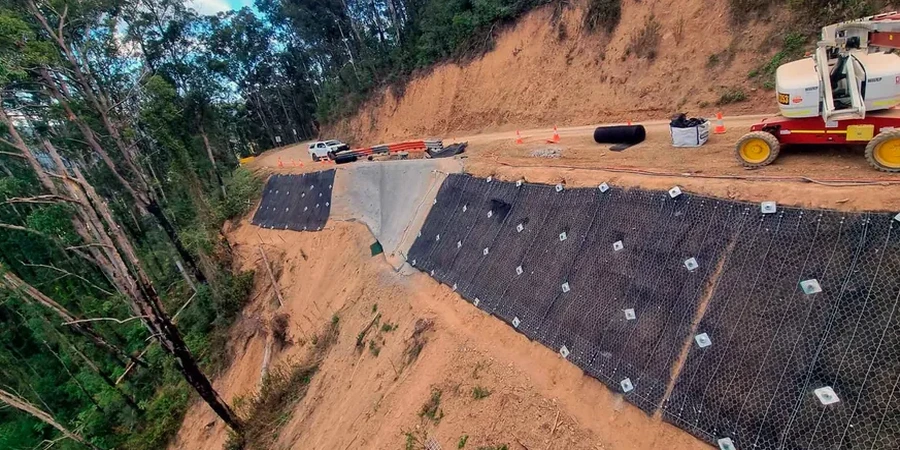
A contractor broke ground on a commercial development along Boulevard Talbot only to discover the cut slope was riddled with laminated silts. Within days of excavation, tension cracks appeared at the crest. Saguenay's topography, carved by glacial retreat into the Saguenay Graben, leaves steep valley walls mantled with sensitive marine clays that lose strength rapidly when disturbed. A detailed slope stability analysis is the only way to quantify that risk before earthworks begin. The analysis models drained and undrained conditions, integrating pore pressure data from the Laflamme Sea deposits that underlie much of the Jonquière and Chicoutimi boroughs. For projects near the Rivière Saguenay or its tributaries, we often pair the stability model with in-situ permeability testing to define groundwater flow nets that control seepage forces within the slope.
In Saguenay's sensitive clays, a factor of safety of 1.0 today can drop below 0.9 within hours of a rainfall event if the slope was designed with undrained peak strength instead of post-peak softened parameters.
Area-specific notes
The risk profile in the Jonquière flats differs sharply from the steep slopes of Chicoutimi-Nord. Jonquière sits on thick, compressible clay where rotational failures can retrogress hundreds of metres inland—the Saint-Jean-Vianney landslide of 1971 remains a stark reminder of what sensitive clays can do. Chicoutimi-Nord, by contrast, deals with shallow translational slides at the till-bedrock contact, often triggered by spring snowmelt infiltration. A project on rue Roussel faces different failure mechanisms than one on boulevard Saguenay, even though they are only fifteen kilometres apart. Understanding which mechanism controls the site is the first step in any stability analysis. The second is selecting the right shear strength envelope: peak, fully softened, or residual. Getting this wrong in Saguenay's post-glacial sediments can mean the difference between a stable slope and a catastrophic flow slide.
Quick answers
How much does a slope stability analysis typically cost for a project in Saguenay?
For sites in Saguenay, budget between CA$1,660 and CA$6,250 depending on slope height, geological complexity, and whether undisturbed sampling and triaxial testing are required. A small residential cut slope analysis falls at the lower end; a commercial development on sensitive clay with instrumentation and FEM modeling reaches the upper range.
What makes Saguenay's soils particularly challenging for slope stability?
The Laflamme Sea marine clays found throughout Saguenay are sensitive, meaning their undisturbed strength can be five to ten times higher than their remolded strength. When a slope fails, the clay liquefies and flows as a viscous liquid rather than sliding as a block. This retrogressive failure mode can propagate far beyond the initial disturbance zone, which is why even small excavations require careful stability assessment.
How long does a slope stability analysis take from start to finish?
A standard analysis for a building permit in Saguenay typically takes three to four weeks from field investigation to final report. That timeline includes drilling, laboratory triaxial testing (which requires about ten days for CIU tests with pore pressure measurement), modeling iterations, and preparation of stamped engineering drawings. Expedited schedules are possible for smaller projects if the site stratigraphy is already well-documented from adjacent work.