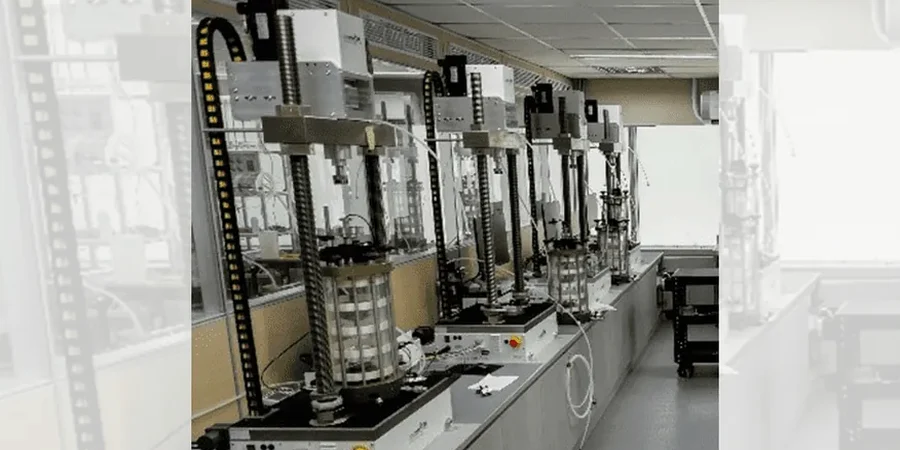
Saguenay sits at an elevation of roughly 166 meters within a graben valley carved by glacial forces, leaving behind a complex stratigraphy of Laflamme Sea marine clays and compact till. Designing foundations or embankments here without verifying shear strength parameters is a gamble no structural engineer should take. We run consolidated-undrained and drained triaxial tests on undisturbed Shelby tube samples to extract effective cohesion (c') and friction angle (φ') directly applicable to bearing capacity and slope stability models. The 1988 Saguenay earthquake—a magnitude 5.9 event centered just 35 km south—reminds us that pore pressure response under cyclic loading must be understood, not assumed. Our laboratory interprets failure envelopes following slope stability criteria specific to the fjord's sensitive clay formations.
Effective stress parameters from a consolidated-undrained triaxial test with pore pressure measurement reduce geotechnical uncertainty by up to 40% compared to total stress approaches alone.
Quick answers
How much does a triaxial test program cost in the Saguenay region?
A typical triaxial testing program on three undisturbed Shelby tube specimens with consolidation, shearing, and engineering report falls between CA$2,700 and CA$4,160. The final figure depends on the number of effective confining stresses, whether you need CU or CD conditions, and the sampling depth. We provide a fixed-price proposal after reviewing the borehole logs and project specifications.
What's the difference between a UU and a CU triaxial test?
An unconsolidated-undrained (UU) test measures total stress strength with no consolidation phase, giving a quick Su for short-term stability. A consolidated-undrained (CU) test consolidates the specimen to in-situ stress first, then shears it while measuring pore pressure, letting us separate effective cohesion and friction — essential for calculating long-term bearing capacity in Saguenay's sensitive clays.
How long does it take to get triaxial test results?
A standard three-specimen CU program with back-pressure saturation typically requires 10 to 14 working days from sample receipt to final report. Consolidation stages alone can take 24 to 48 hours per specimen in the low-permeability marine clays found beneath Saguenay. We expedite schedules when phased results are needed for ongoing earthworks.
Can you test coarse granular soils from the Saguenay till deposits?
Yes. For granular till with particles up to 19 mm, we use a 70-mm-diameter specimen and consolidated-drained protocol. Larger cobbles require scalping or replacement techniques. We coordinate with the drilling crew to preserve intact block samples from test pits — a test pit investigation often yields better-quality specimens in these formations than conventional tube sampling.