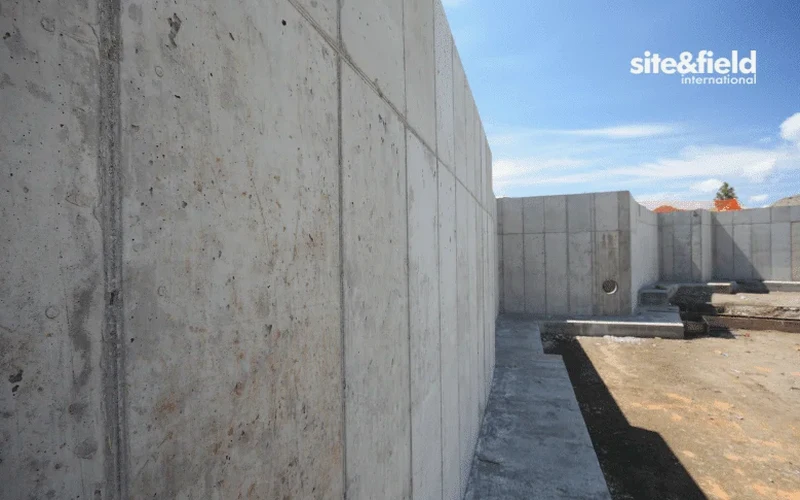
A contractor in the Jonquière borough recently uncovered a textbook case of the Saguenay subsurface: a thin crust of silty sand over forty feet of varved clay, with groundwater seeping in at just two meters depth. The project called for a seven-meter-high cantilever wall to terrace a sloping commercial lot. The challenge wasn't just holding back the earth; it was designing a structure that could survive the annual freeze-thaw cycle that reaches over two meters deep in this part of Quebec, without being jacked out of position. We see this scenario often when conventional designs imported from milder regions fail to account for the cryogenic pressures and the low shear strength of the local marine deposits. What makes retaining wall design here distinct is the need to integrate frost-protection measures, solid drainage behind the wall, and a very careful reading of the slope stability analysis, especially when sensitive clays are involved.
In the Saguenay region, a retaining wall is not just a structure; it is a thermal and hydraulic interface that must manage the energy of freezing ground.
Scope of work
The Saguenay graben, underlain by the sensitive Laflamme Sea clays, presents a geotechnical profile that demands a specific approach to retaining structures. The undisturbed shear strength of these clays can be misleadingly high, but any remolding from excavation or poor drainage can reduce it drastically, a phenomenon known as sensitivity. For tall walls, we often couple a detailed site characterization using
CPT testing to map the depth of the intact crust with a design methodology rooted in the Canadian Foundation Engineering Manual. The frost action in Saguenay, where the freezing index can exceed 2000°C-days, necessitates that wall footings bear well below the frost line, typically a minimum of 1.8 meters, and that backfill is a clean, free-draining granular material. We also consider the high horizontal stresses locked into the clay from glacial retreat, which can increase lateral pressures on the wall beyond classical Rankine theory, requiring a more nuanced structural analysis of the stem and base slab.
Area-specific notes
We often deploy a track-mounted drill rig on Saguenay projects, capable of pushing CPT cones and sampling the clay with thin-walled Shelby tubes, right from the footprint of the proposed wall. The main risk we see is not overturning, but a deep-seated rotational failure that starts behind the wall and arcs out into the slope, mobilizing the sensitive clay layer. In our experience, the most common callbacks are for walls that have tilted forward after a single winter, not because the reinforcement was undersized, but because ice lensing in the backfill created thrust that was never accounted for in the original calculation. A proper in-situ permeability test of the backfill and native soil is crucial; without it, the drainage system is just a guess. The design must explicitly account for the reduction in passive resistance at the toe if the soil is allowed to freeze, which is why we always specify rigid insulation boards on the back of the stem for walls over two meters in height.
Quick answers
What is the typical cost range for a retaining wall design in Saguenay?
For a site-specific retaining wall design in the Saguenay region, including a geotechnical investigation, structural calculations, and stamped drawings, the fee typically falls between CA$1,530 and CA$5,960. The range depends on the wall height, the complexity of the soil profile, and the level of frost-protection detailing required.
How does the sensitive clay in Saguenay affect the design?
The Laflamme Sea clays have a high sensitivity, meaning they lose significant strength when disturbed. This requires us to use a lower bound strength for the passive zone and to carefully check global stability using post-peak parameters. We also avoid construction methods that cause vibration or remolding near the toe of the wall.
Why is insulation sometimes specified on the back of a retaining wall?
In Saguenay, the deep frost penetration can freeze the backfill, which expands and exerts enormous pressure on the wall. By placing a layer of extruded polystyrene insulation on the back of the stem, we can trap heat from the ground and prevent the backfill from freezing, drastically reducing the lateral thrust on the structure.