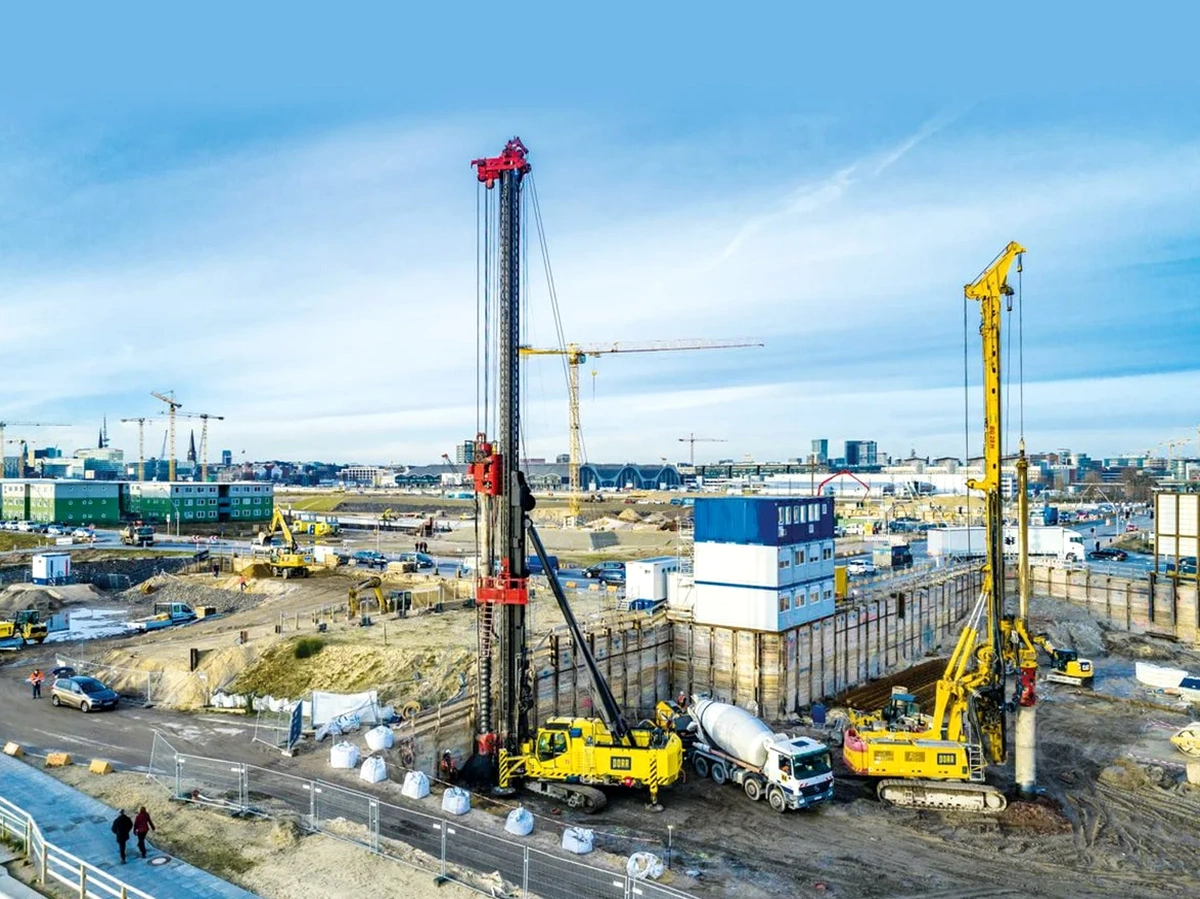
Foundation conditions in Saguenay shift dramatically between the bedrock-controlled terraces of Chicoutimi and the deep post-glacial clays blanketing La Baie, where the Saguenay Fjord deposited over 100 meters of soft marine sediments during the last deglaciation. A shallow footing design that performs adequately on the compact till of the upper terraces can experience total settlement failure just a few kilometers south, where the sensitive Champlain Sea clays exhibit remolding sensitivity that complicates pile foundation design. The 1988 Saguenay earthquake, a magnitude 5.9 event, demonstrated that these clay deposits are susceptible to severe amplification and cyclic degradation, making seismic pile performance a non-negotiable element of any deep foundation scope. Our team integrates site-specific seismic response analysis with advanced liquefaction assessment protocols to define the kinematic and inertial demands on the pile shaft, ensuring the design accommodates both static settlement from the compressible clay and dynamic lateral spreading from the underlying liquefiable silt lenses identified across the Jonquière sector.
In Saguenay's post-glacial clays, pile capacity is governed not by the structural section but by the soil-structure interface degradation under repeated seismic loading.
Scope of work
The extreme winter conditions in Saguenay, where frost penetration can reach depths of 2.5 meters and air temperatures routinely drop below -30°C, impose a thermal contraction regime on pile caps and grade beams that must be explicitly modeled in the structural connection detailing. Unlike projects in the Montreal region, where competent limestone is encountered at shallow depths, the deep soil profile here—often exceeding 60 meters before reaching the Precambrian basement—requires friction pile designs that mobilize shaft resistance within the stiff glacial till interbedded with the marine clay. Our approach, calibrated through laboratory triaxial testing on undisturbed Shelby tube samples, quantifies the drained and undrained shear strength parameters that govern the alpha and beta coefficients used in the axial capacity calculations per CFEM guidelines. When the upper clay crust exhibits desiccation cracking from seasonal moisture fluctuation, we complement the in-situ investigation with
CPT testing to obtain a continuous profile of tip resistance and sleeve friction, a dataset that identifies thin sand stringers capable of acting as preferential drainage paths that accelerate consolidation settlement around the pile group. For projects near the Rivière Saguenay, where riverbank erosion exposes the pile cap to potential scour, the design must also incorporate a minimum embedment depth below the estimated contraction scour elevation, a criterion that our hydraulic assessments derive from the 100-year flood event documented in the regional watershed management plan.
Area-specific notes
A recurring mistake in the Saguenay market is the specification of a uniform pile length across a site without accounting for the lateral variability of the marine clay thickness, a shortcut that results in some piles terminating in soft clay above the competent till while others reach refusal in the underlying rock, creating a differential stiffness condition that attracts eccentric load distribution into the pile cap. This occurs when geotechnical investigations rely solely on boreholes spaced at 30-meter intervals, a grid that misses the infilled bedrock valleys and paleo-channels that are common throughout the Saguenay graben. The consequence is a foundation system where the stiffer, rock-socketed piles shed their load through end-bearing while the shorter piles rely on friction that degrades under the cyclic pore pressure buildup during a seismic event, leading to a progressive failure mechanism that was well-documented in post-earthquake reconnaissance reports from similar tectonic settings. Our pile foundation design protocol mitigates this by requiring a minimum of one investigation point per 400 square meters of building footprint when the site is underlain by the La Baie clay formation, combined with a seismic refraction survey to map the bedrock topography before finalizing pile tip elevations.
Standards used
NBCC 2020 — Division B, Part 4 (Structural Design) and seismic provisions for Saguenay (Sa(0.2) ≥ 0.55g), CSA A23.3:19 — Design of concrete structures, including deep foundation provisions for seismic detailing, CFEM (Canadian Foundation Engineering Manual), 4th Edition — axial and lateral pile capacity calculation methods, ASTM D1143/D1143M — Standard Test Methods for Deep Foundation Elements Under Static Axial Compressive Load, ASTM D4945 — Standard Test Method for High-Strain Dynamic Testing of Deep Foundations, ASTM D1586 — Standard Test Method for Standard Penetration Test (SPT) and Split-Barrel Sampling of Soils
Quick answers
What is the typical cost range for a pile foundation design package for a commercial building in Saguenay?
For a comprehensive pile foundation design package that includes the geotechnical investigation planning, axial and lateral capacity analysis, pile group settlement assessment, and construction specification preparation for a typical commercial structure in Saguenay, project fees generally range from CA$2,520 to CA$8,760. The final cost depends on the building footprint, the number of distinct pile types, the complexity of the seismic analysis required under NBCC, and the extent of the field investigation that must be integrated into the design model.
How does the sensitive marine clay in La Baie affect the pile design compared to the Chicoutimi area?
The Champlain Sea clays in the La Baie sector exhibit sensitivity values (St) often exceeding 15, meaning that any disturbance during pile installation—particularly from driven piles—can reduce the undrained shear strength by more than 90% at the pile-soil interface. This requires the use of displacement-reduced installation methods like continuous flight auger piles, and the design must incorporate a remolded strength envelope for the shaft friction calculation along the clay segments. In Chicoutimi, where the till is shallower and less sensitive, driven H-piles can mobilize higher unit shaft resistance with less installation-induced degradation.
What level of seismic analysis is required for pile foundations in Saguenay given the 1988 earthquake history?
Under NBCC 2020, Saguenay falls within a moderate-to-high seismic hazard zone with a 2% in 50-year spectral acceleration Sa(0.2) of approximately 0.55g on Site Class C. For pile foundations on Site Class D or E soils, the code requires a site-specific seismic response analysis to account for the amplification effects that the soft clay column imposes on the ground motion. This analysis must evaluate both the inertial forces transferred from the superstructure to the pile head and the kinematic bending moments induced by the soil deformation profile during shaking, particularly at the interface between the soft clay and the underlying stiffer till where a sharp stiffness contrast develops.