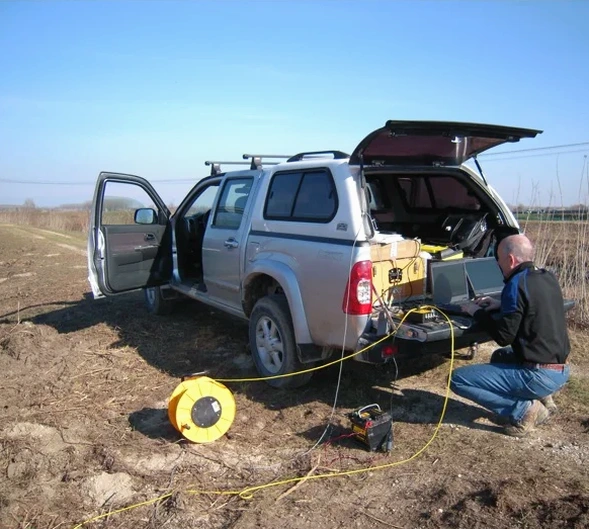
In Saguenay, understanding what lies beneath the surface is not a formality—it is a prerequisite for safe construction. This region sits within the Saguenay Graben, a seismically active rift zone that produced the 1988 M5.9 earthquake, and the variable overburden of glacial and post-glacial sediments demands high-resolution geophysical investigation. We apply seismic tomography, both refraction and reflection, to image subsurface velocity contrasts, map bedrock topography, and identify low-velocity zones associated with faults or fractured rock. Our fieldwork adheres to ASTM D5777 and integrates with NBCC 2015 seismic hazard requirements, providing engineers with P-wave and S-wave velocity models essential for site class determination. The resulting 2D tomographic profiles reveal the geometry of the limestone and shale bedrock beneath the thick Quaternary deposits typical of the Saguenay Lowlands, allowing for informed decisions on excavation depth, foundation type, and seismic design parameters without excessive drilling.
Seismic tomography in the Saguenay Graben reveals the velocity contrast between intact rock and faulted zones, a critical input for any seismic design that cannot be captured by boreholes alone.
Quick answers
What is the difference between seismic refraction and reflection tomography?
Refraction uses first-arrival traveltimes from waves that critically refract along velocity boundaries, providing a model of the top 15–60 m. Reflection records energy bounced back from acoustic impedance contrasts, imaging deeper structures (30–200+ m) with higher vertical resolution. In Saguenay, refraction is the standard for bedrock mapping and rippability; reflection is specified when fault delineation or deep basin geometry is required.
How much does a seismic tomography survey cost in Saguenay?
A complete seismic tomography survey in the Saguenay region typically ranges from CA$3,730 to CA$6,180, depending on the array length, number of shot points, and whether P-wave only or combined P- and S-wave acquisition is required. A fixed-price proposal is provided after reviewing the site plan and target depth.
Can seismic tomography replace boreholes on a Saguenay site?
Seismic tomography complements boreholes but does not replace them entirely. The velocity model provides continuous lateral coverage, revealing hidden features like fault zones or abrupt bedrock steps that boreholes can miss. However, a limited number of boreholes or test pits are still advisable to calibrate the velocity-to-lithology relationship and to sample soil for laboratory testing.