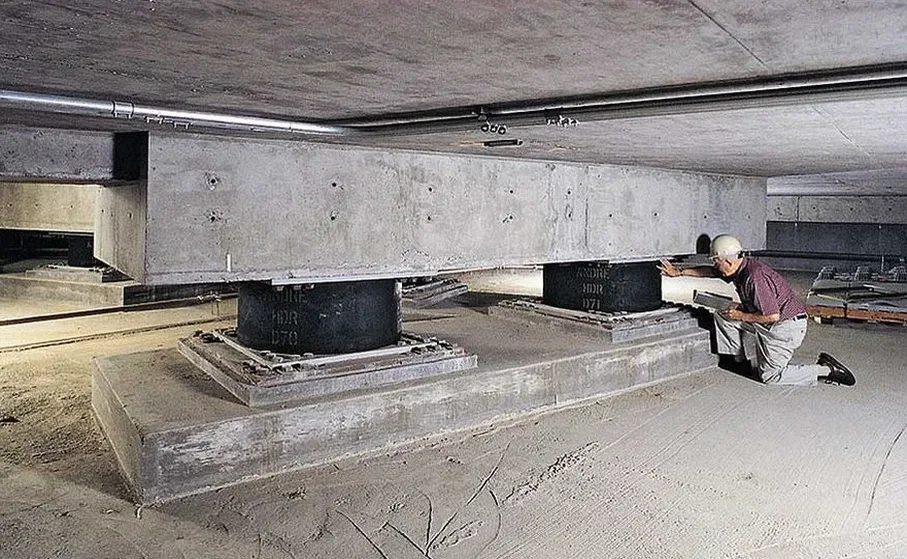
Saguenay sits in one of the most active seismic zones in eastern Canada, where the Charlevoix Seismic Zone generates concentrated crustal stress less than 60 km from the city center. Combine that proximity to M6+ source zones with the deep marine and lacustrine clay deposits of the Saguenay Graben, and you get a design problem that conventional fixed-base solutions handle poorly. The 1988 M5.9 Saguenay earthquake reminded everyone that stiff glacial sediments can transmit high-frequency motion efficiently, even at substantial epicentral distances. In our experience, base isolation seismic design shifts the performance conversation from ductile damage control to genuine operational continuity—something critical for hospitals, emergency centers, and industrial facilities in the Jonquière and Chicoutimi sectors. We complement site-specific hazard deaggregation with seismic microzonation studies to capture basin-edge effects before isolator properties are finalized, and we often reference liquefaction screening results when isolator moat walls must remain functional after lateral spreading displaces surrounding grade.
A well-tuned isolation system in Saguenay can cut base shear by more than half, but only if low-temperature isolator behavior and basin-edge effects are explicitly modeled.
Area-specific notes
In Saguenay, we consistently see two risks that generic isolation designs miss. First, the combination of soft clay stratigraphy and high water table—often within 2 m of grade near the Rivière Saguenay—means that moat retaining walls experience large seismic earth pressures plus hydrostatic loading simultaneously; if the isolation gap is calculated only for superstructure displacement, the wall-soil system can lock up during long-duration Charlevoix sequences. Second, basin-edge geometry in the graben can generate surface waves that amplify vertical motion at periods between 0.3 and 0.8 seconds, a range that couples into the isolation layer when friction pendulum sliders experience axial force variation. We address this by modeling vertical ground motion components explicitly and by checking uplift restraint hardware under maximum considered earthquake (MCE) demands. Frost penetration to 2.0–2.5 m depth also requires that the isolation plane be placed below the frost line or within a conditioned crawl space, otherwise heave can tilt bearing plates and alter the friction coefficient distribution across the isolator array.
Standards used
NBCC 2020 — Division B, Part 4 (Seismic Design), CSA S832-14 — Seismic risk reduction of operational and functional components in buildings, ASCE/SEI 7-22 — Minimum Design Loads, Chapter 17 (Seismic Isolation), ASTM D4014 — Standard Specification for Plain and Steel-Laminated Elastomeric Bearings, NCHRP Report 472 — Comprehensive Specification for Seismic Isolation of Bridges
Quick answers
How much does a base isolation seismic design study cost for a building project in Saguenay?
For a typical mid-rise structure in the Saguenay area, a complete base isolation design package—including nonlinear time-history analysis, isolator specification, and peer review documentation—ranges from CA$5,040 to CA$11,220 depending on the number of ground motion records processed and the complexity of the superstructure model. Projects requiring multiple isolation plane configurations or special low-temperature prototype testing fall toward the upper end.
What ground motion records are appropriate for time-history analysis in the Saguenay Basin?
We select records from the Charlevoix Seismic Zone and analogous tectonic environments—stable continental regions with concentrated intraplate seismicity. Each suite is spectrally matched to the NBCC 2020 uniform hazard spectrum for Saguenay at the 2% in 50-year hazard level, typically using 11 horizontal pairs scaled per orthogonal direction. We include at least two records from the 1988 Saguenay mainshock and its aftershocks to preserve local path and site effects.
Is base isolation feasible on the sensitive clays found throughout Saguenay?
Yes, but it requires careful foundation design. The isolation plane sits above the foundation, so the soil-structure interaction problem is decoupled: the foundation system—often deep piles bearing in till or rock below the Laflamme Sea clays—must handle seismic demands from the reduced base shear, while the isolation layer handles superstructure drift. We run separate soil-pile interaction analyses to confirm that cyclic degradation of sensitive clay around pile groups does not compromise moat wall stability under MCE displacements.