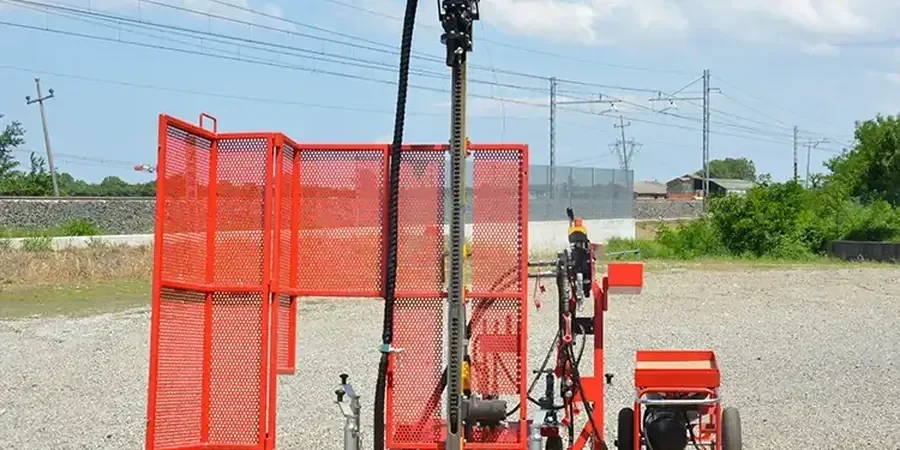
The Saguenay basin sits on a deep sequence of post-glacial marine clays, the famous Laflamme Sea sediments, often reaching 60 meters before hitting till or rock. Anyone who has drilled near the Chicoutimi riverbanks knows the interbedded silts can fool you — stiff at the spoon but highly sensitive when remolded. We run our SPT program with that exact sensitivity in mind, because blow counts alone don't tell the full story in these Champlain Sea-type deposits. A good split-spoon recovery paired with our lab's index testing — Atterberg limits run the same day — quickly flags the difference between a competent silt and a quick clay that could spell trouble for footings. With Saguenay sitting in a moderate seismic zone (NBCC 2020 zone with Sa(0.2) around 0.4-0.5 g), the SPT data feeds directly into liquefaction screening and site class determination per the National Building Code.
An N-value without the energy correction is just a number — with ASTM D1586-18 calibration, it becomes an engineering parameter for Saguenay's sensitive clays.
Standards used
ASTM D1586-18 — Standard Test Method for Standard Penetration Test (SPT) and Split-Barrel Sampling of Soils, NBCC 2020 — National Building Code of Canada, seismic provisions and site classification, CSA A23.3 — Design of Concrete Structures, reference for geotechnical input parameters, Youd & Idriss (2001) — NCEER Workshop on Evaluation of Liquefaction Resistance, Seed & Idriss (1982) — Ground Motions and Soil Liquefaction During Earthquakes
Quick answers
How much does an SPT investigation cost for a typical Saguenay residential lot?
For a single-family residential project in the Saguenay area, a basic SPT program with one borehole to 10-12 meters depth, energy calibration, and lab testing on selected samples typically ranges from CA$800 to CA$910. The final number depends on access conditions, depth to refusal, number of samples sent to the lab, and whether we need to install a monitoring well.
What depth do you typically drill for SPT in the Saguenay clay belt?
In the Laflamme Sea clay deposits that dominate the Saguenay lowlands, we usually target 15 to 25 meters depth, or until we hit competent till or bedrock. The NBCC 2020 site classification requires shear wave velocity or SPT data over the top 30 meters, so if the project is a multi-storey building, we extend to 30 meters. The stiff crust in the Jonquière-Chicoutimi corridor often delays the soft clay until 4-6 meters, so stopping at 8 meters can completely miss the critical layer.
How do you handle SPT in the quick clays we have in the region?
Sensitive marine clays — the so-called quick clays — are common in the Saguenay basin, and the SPT procedure itself can remold them if we are not careful. We use thin-walled Shelby tubes alongside the split-spoon to recover undisturbed samples for lab testing, and we log the SPT blow counts with notes on sample disturbance. The key is comparing field vane shear strength with the N60 correlation: if the SPT overestimates strength in a high-sensitivity clay, the lab Atterberg limits and sensitivity measurements tell us by how much. That information is critical for slope stability work and any excavation near the river.