← Home · In-Situ

Field Density Testing (Sand Cone Method) in Saguenay

Together, we solve the challenges of tomorrow.

SEE MORE →

A common oversight in Saguenay’s construction sector is assuming that compaction specifications are met just because the roller made the specified number of passes. We have seen embankment layers fail verification because the underlying silty sand, typical of the Saguenay Graben, reacted differently to moisture than the lab curve predicted. The sand cone test (ASTM D1556) eliminates that guesswork by providing a direct measurement of in-place dry density, letting you compare field compaction against the Proctor maximum dry density determined in our laboratory. When the project involves structural backfill against retaining walls or beneath footings on the region’s glaciomarine deposits, this test becomes the contractual linchpin for sign-off.

In Saguenay’s silty-sand fills, a 1.5 % increase in moisture above optimum can cut the measured dry density by 80–120 kg/m³ — sand cone data catches that drop before the next lift goes in.
Scope of work

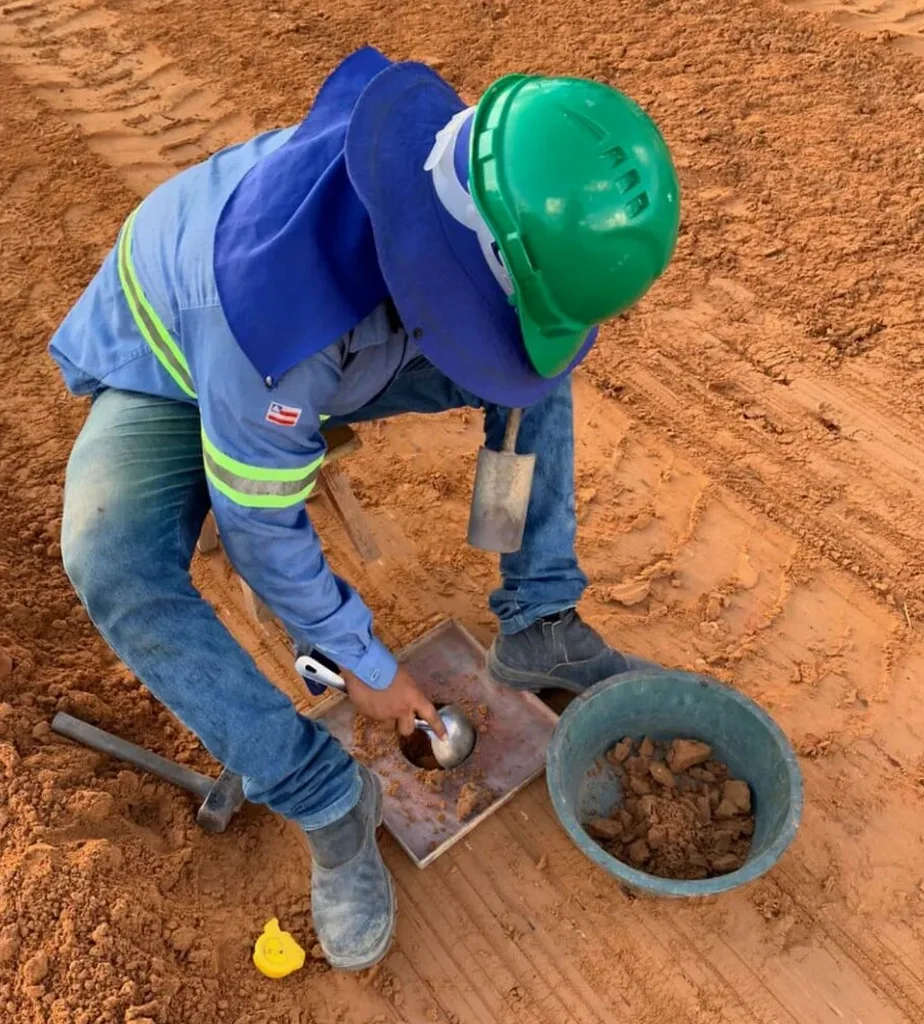
Saguenay sits on a mix of Laflamme Sea clays and coarser deltaic sands, with groundwater often found within 2 to 4 m of surface in the Jonquière and Chicoutimi sectors. These conditions create a narrow moisture window for compaction: too dry and the sand fraction crumbles, too wet and the silt matrix pumps under the tamper. Our field crew runs the sand cone test using calibrated Ottawa sand (bulk density check every 10 holes), following ASTM D1556-15 and referencing the moisture correction in ASTM D2216. For granular subgrades, we often pair the test with a grain-size analysis to confirm the fill matches the approved borrow source, while on cohesive fills the Atterberg limits help explain density trends that deviate from the spec. The test itself is destructive only to a depth of 15–20 cm, but the data it yields anchors the entire compaction report for engineers reviewing lift approval.
Field Density Testing (Sand Cone Method) in Saguenay
Technical reference image — Saguenay

Area-specific notes

A 4-storey mixed-use building on Talbot Boulevard in Chicoutimi had its underground parking backfill rejected twice before we were called in. The contractor was using a nuclear gauge without sand cone correlation, and the readings were skewed by the high mica content in the local borrow. We ran a grid of sand cone tests at the disputed lift and found the actual compaction was 91 % of standard Proctor — three points below the 95 % required for structural backfill. The delay cost two weeks of schedule and required re-compaction with adjusted moisture. In Saguenay, where the construction season is compressed by early snowfall, a failed density test in October can push sign-off into November, exposing the excavation to freeze-thaw cycles that degrade the fill. We recommend sand cone verification at the first lift and whenever the fill source changes.

Need a geotechnical assessment?

Reply within 24h.

Email: contact@geotechnicalengineering.co

Reference parameters


ParameterTypical value
Standard methodASTM D1556-15 (Sand Cone)
Alternate rapid methodASTM D6938 (Nuclear Gauge, used with sand cone calibration)
Test depth15–20 cm, adaptable for thin lifts
Sand calibration frequencyEvery 10 test holes or each day, whichever comes first
Minimum test frequency (earthwork)1 per 500 m² per lift (CSA A23.3 and OPSS reference)
Reported parametersWet density, dry density, moisture content, % compaction relative to Proctor
Particle size limitationMax 50 mm; oversized particles corrected via ASTM D4718

Linked services

01

In-Place Density QA/QC

Systematic sand cone testing on engineered fills, pipe bedding, and structural backfill, with real-time compaction curves plotted against the laboratory Proctor.

02

Nuclear Gauge Correlation

On large earthworks, we establish site-specific sand cone correlations for nuclear gauges, improving test speed while maintaining ASTM D6938 traceability.

03

Borrow Source Verification

Field density combined with grain-size and Atterberg testing to confirm that delivered fill matches the approved borrow source specifications.

04

Compaction Troubleshooting

When lifts fail, we diagnose whether the cause is moisture, gradation, lift thickness, or compactor effort, and recommend corrective actions before rework.

Standards used


ASTM D1556-15, ASTM D2216 (moisture content), ASTM D698 / D1557 (Proctor reference), CSA A23.3 (concrete structures — backfill section), BNQ 2501-070 (MTOQ equivalent)

Quick answers

How much does a sand cone density test cost in Saguenay?

A single sand cone test in the Saguenay area typically ranges from CA$150 to CA$210, depending on access conditions and the number of points per day. A full-day rate for continuous QA/QC testing is more economical when multiple lifts require verification.

How many sand cone tests are required per lift in Saguenay?

The standard reference is one test per 500 m² per compacted lift, but the exact frequency depends on the project specification. Critical zones like footing subgrades or retaining wall backfill often require tighter spacing — we work with the geotechnical engineer to define the grid before compaction begins.

Can the sand cone method be used in freezing temperatures?

Yes, but with precautions. In Saguenay, late-fall testing requires that the sand and cone be kept above freezing to prevent moisture condensation that alters the sand’s bulk density. We also protect the test hole from frost until the measurement is complete, and note ground temperature on the report for the engineer’s interpretation.

Location and service area

We serve projects across Saguenay and surrounding areas.

View larger map