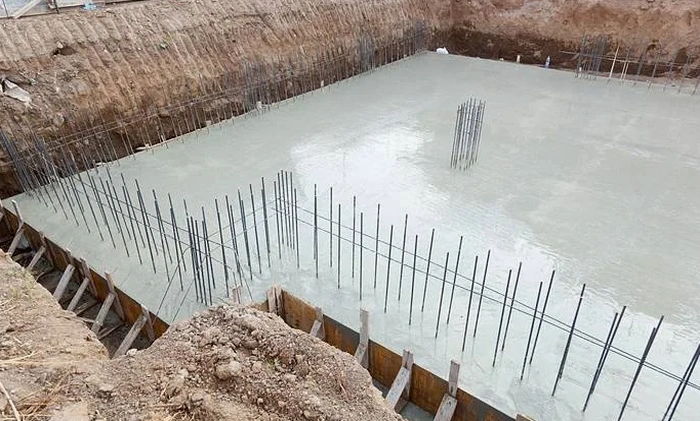
In Saguenay, we often see contractors surprised by foundation movements that trace directly back to the Champlain Sea clay. This marine clay, deposited thousands of years ago, covers wide portions of the Jonquière and Chicoutimi areas. The clay is sensitive and loses strength when disturbed. A shallow foundation design here cannot rely on textbook assumptions. It must account for the crust thickness, the depth to competent till, and the groundwater perched within the silt layers. We integrate CPT soundings and test pit observations to map these conditions before sizing the footings. For heavily loaded structures near the Rivière Saguenay terrace, combining the design with a stone column Improvement strategy often reduces differential settlement to acceptable limits.
On Saguenay's sensitive clays, bearing capacity is rarely the problem — post-construction settlement is the real design driver.
Area-specific notes
The most common mistake we see in Saguenay is placing footings directly on the desiccated crust without checking what lies beneath. The crust, usually 1.5 to 2 meters thick, is stiff and oxidized. It feels competent during excavation. But below it, the soft, grey sensitive clay can be 20 meters thick. A footing bearing on the crust can punch through if the bulb of pressure reaches the soft layer. The second error is underestimating frost heave. A footing placed at 1.2 meters depth in silty backfill will heave. We insist on bearing directly on native, undisturbed till or on a properly designed granular pad that extends below frost depth. The NBCC 2020 seismic provisions also amplify ground motions on these soft soil sites, so we check liquefaction susceptibility even for shallow foundations in the low-lying areas near the Ha! Ha! River basin.
Quick answers
What is the biggest challenge for shallow foundations in Saguenay?
The presence of thick, sensitive Champlain Sea clay beneath a thin surface crust. The clay is prone to large settlements and strength loss when remolded. Designing a shallow foundation requires verifying that the pressure bulb remains within the stiff upper crust or transferring the load to deeper till.
How deep do footings need to be in Saguenay?
The minimum depth to the underside of the footing is typically 1.5 m to 1.8 m to comply with frost protection standards (CSA S501). In some areas with high groundwater, we recommend a deeper excavation to reach undisturbed material and install a working platform.
How much does a shallow foundation geotechnical investigation cost locally?
For a residential or light commercial structure in Saguenay, the field investigation and engineering report typically range from CA$2,740 to CA$3,700, depending on access, number of test pits, and laboratory testing requirements.
Can we build a raft slab directly on the clay?
It depends on the clay sensitivity and the load distribution. A rigid raft can bridge soft spots, but we need to calculate the differential settlement first. If the clay is highly sensitive, we often recommend a structural floor or a layer of compacted engineered fill above the geotextile.
Do you need to test for seismic effects on shallow foundations here?
Yes. The NBCC 2020 assigns a seismic hazard value for Saguenay, and the soft clay soils often classify as Site Class E. This amplifies the ground motion. We evaluate bearing capacity reduction and potential cyclic softening under the design earthquake.