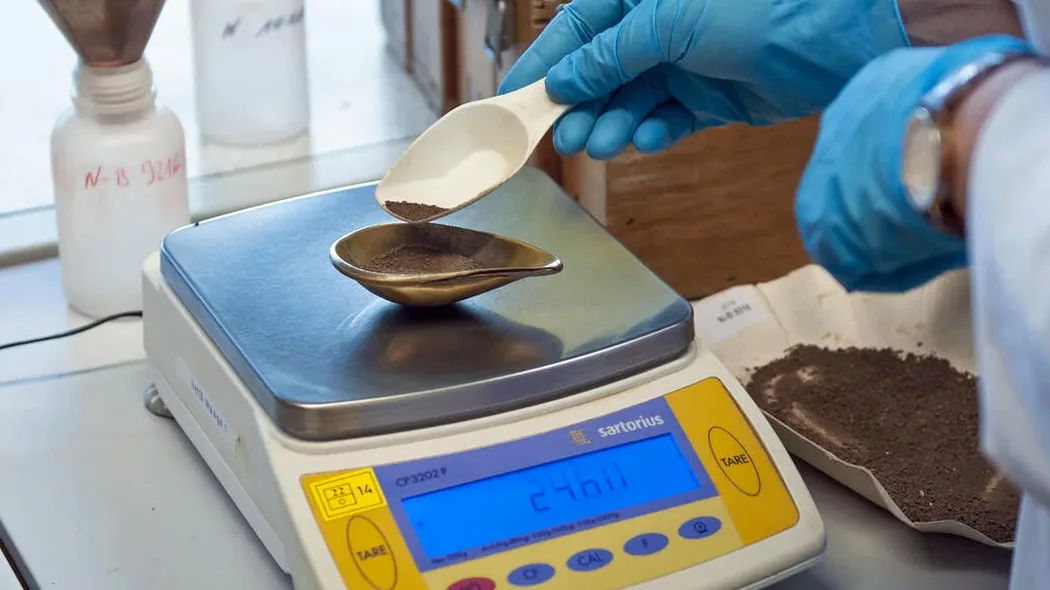
The Saguenay region presents a unique geotechnical signature shaped by the last glaciation and the subsequent marine incursion into the Saguenay Graben. Local deposits range from dense glacial tills on the higher terraces of Jonquière to the notoriously sensitive silty clays of the La Baie lowlands, a legacy of the post-glacial Laflamme Sea. When foundation design or slope stability assessment relies on material behavior, a simple visual classification is insufficient. A complete grain size analysis, combining mechanical sieving and hydrometer sedimentation per CSA + ASTM D422 and ASTM D6913, is the only way to quantify the exact distribution from cobbles down to the colloidal clay fraction. This data feeds directly into liquefaction potential assessments and drainage design for infrastructure across the city's variable microclimates. For projects encountering soft compressible layers, our team often recommends pairing this analysis with a CPT test to correlate particle size with in-situ strength and pore pressure response.
In Saguenay's sensitive clay deposits, the grain size curve isn't just a classification—it's a first-order stability screening tool tied directly to the liquid limit and remolded strength.
Area-specific notes
The urban expansion of Saguenay, particularly the post-merger development linking Chicoutimi, Jonquière, and La Baie, has pushed construction into geologically complex corridors. The greatest subsurface risk stems from the region's sensitive clays: materials that lose a dramatic percentage of their strength when remolded or subjected to excess pore pressure. A grain size analysis that shows a high clay fraction with plasticity indices above 20 is a red flag that demands immediate attention. Misclassifying a silty clay as a lean clay can lead to underestimated lateral earth pressures on retaining walls or inadequate drainage behind them. Furthermore, ignoring the silt content in a seemingly clean sand can result in severe frost heave damage during a typical Saguenay winter, where frost penetration reaches depths of over 2 meters. The cost of excavation and structural repair far outweighs the investment in precise laboratory testing before construction begins.
Quick answers
How long does a complete sieve and hydrometer analysis take in your Saguenay lab?
Standard turnaround for a full grain size analysis, including the hydrometer sedimentation phase, is typically 3 to 5 business days after sample receipt. The hydrometer portion requires a controlled temperature environment and timed readings over a 24-hour period, which cannot be accelerated. We offer expedited processing for urgent projects where the soil classification is needed to avoid construction downtime.
What is the typical cost range for a grain size analysis on a Saguenay project?
For a standard combined sieve and hydrometer analysis, the fee generally ranges from CA$150 to CA$260 per sample, depending on whether it's a single point or part of a larger geotechnical investigation batch. This includes the full gradation curve report, calculation of uniformity and curvature coefficients, and a recommendation on USCS classification.
Why is the hydrometer test necessary if we already see the soil is mostly sand?
Even a sand that appears clean to the naked eye can contain 5% to 12% fines, which dramatically alters its engineering behavior. In Saguenay, a small fraction of glacial rock flour can make a sand highly frost-susceptible. The hydrometer analysis is the only ASTM-standardized method to quantify the sub-75-micron fraction, providing the data needed to select appropriate drainage filters and predict capillary rise.