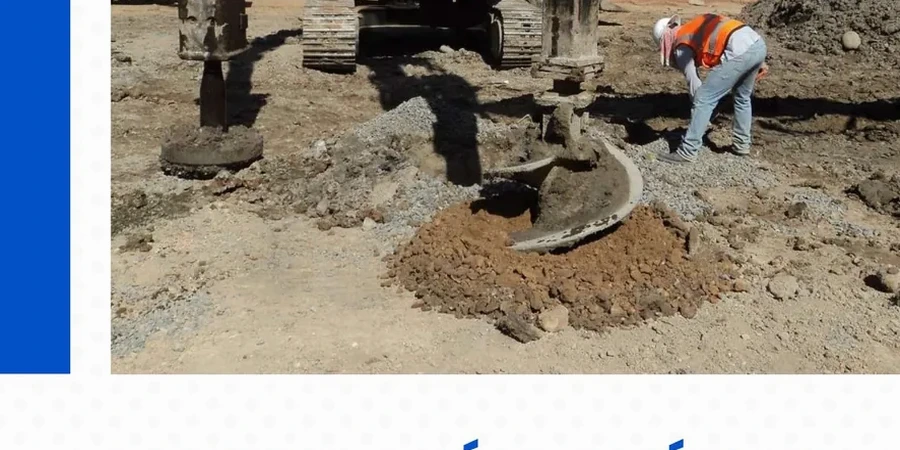
We have seen too many projects in Saguenay where Improvement was treated as an afterthought. The result is almost always differential settlement, cracked slabs, or worse. The Saguenay graben presents a unique set of challenges that generic stone column designs simply cannot address. When you are dealing with thick sequences of Laflamme Sea clays, the margin for error shrinks dramatically. A proper stone column design must start with a clear understanding of the undrained shear strength profile and the sensitivity of the native soil. Skip this step and you will pay for it during construction, guaranteed. We integrate site-specific data from CPT testing to refine the replacement ratio and column length before any rig mobilizes.
Stone columns in Saguenay's sensitive clays are not just about bearing capacity—they are about controlled drainage and preserving the soil's undisturbed structure.
Scope of work
The Quaternary geology of the Saguenay–Lac-Saint-Jean region is dominated by post-glacial marine and fluvial deposits. In many areas, the clay crust is underlain by sensitive silty clay with liquidity indices that approach or exceed 1.2. This is not a forgiving material. When we design stone columns here, the primary objective shifts from simple bearing capacity improvement to bulk mass stabilization and drainage. The columns must function as vertical drains to accelerate the dissipation of excess pore pressures during the consolidation phase. A typical installation in the Jonquière sector might penetrate 8 to 14 meters through desiccated crust and into the soft marine unit below. We specify rounded, hard, clean aggregate graded between 25 and 50 mm to minimize clogging and maximize frictional interlock. The installation method, usually a bottom-feed vibroflot, is selected based on the sensitivity of the clay, which in Saguenay can exceed 30 in the undisturbed state. This approach, combined with load transfer platforms, allows us to support embankments and lightly loaded structures without triggering large deformations.
Area-specific notes
The contrast between zones in Saguenay is stark. In Chicoutimi, you often encounter granular terraces overlying rock at shallow depth; ground conditions are relatively predictable. Cross the river into La Baie, however, and you are working on thick, compressible clay deposits that were once the bottom of a post-glacial fjord. Failing to distinguish between these two settings is a common and costly mistake. The 1988 Saguenay earthquake—a magnitude 5.9 event—reminded every engineer here that seismic performance is not optional. In soft clays, stone columns reduce the risk of liquefaction-like strength loss by providing drainage paths and reinforcing the mass. Without them, a cyclic load can trigger a sudden loss of bearing capacity that no shallow footing can survive. We have seen the data; we know the risk is real.
Quick answers
What is the typical cost range for stone column design in Saguenay?
For a complete design package—including feasibility review, detailed column layout, and construction specifications—the fee typically ranges from CA$1,860 to CA$7,770, depending on the structure's footprint and the complexity of the soil profile.
How do you verify that the stone columns are performing as designed?
We specify post-installation verification using a combination of cone penetration testing through the column and surrounding soil, plate load tests on individual columns, and monitoring of settlement markers during the consolidation period.
Can stone columns prevent liquefaction in Saguenay's seismic environment?
They are not a universal solution for all soils, but in sandy silts and silty sands susceptible to liquefaction, stone columns act as drains to rapidly dissipate excess pore pressure. The design must be calibrated with site-specific seismic demand per NBCC 2020 for the Saguenay region.