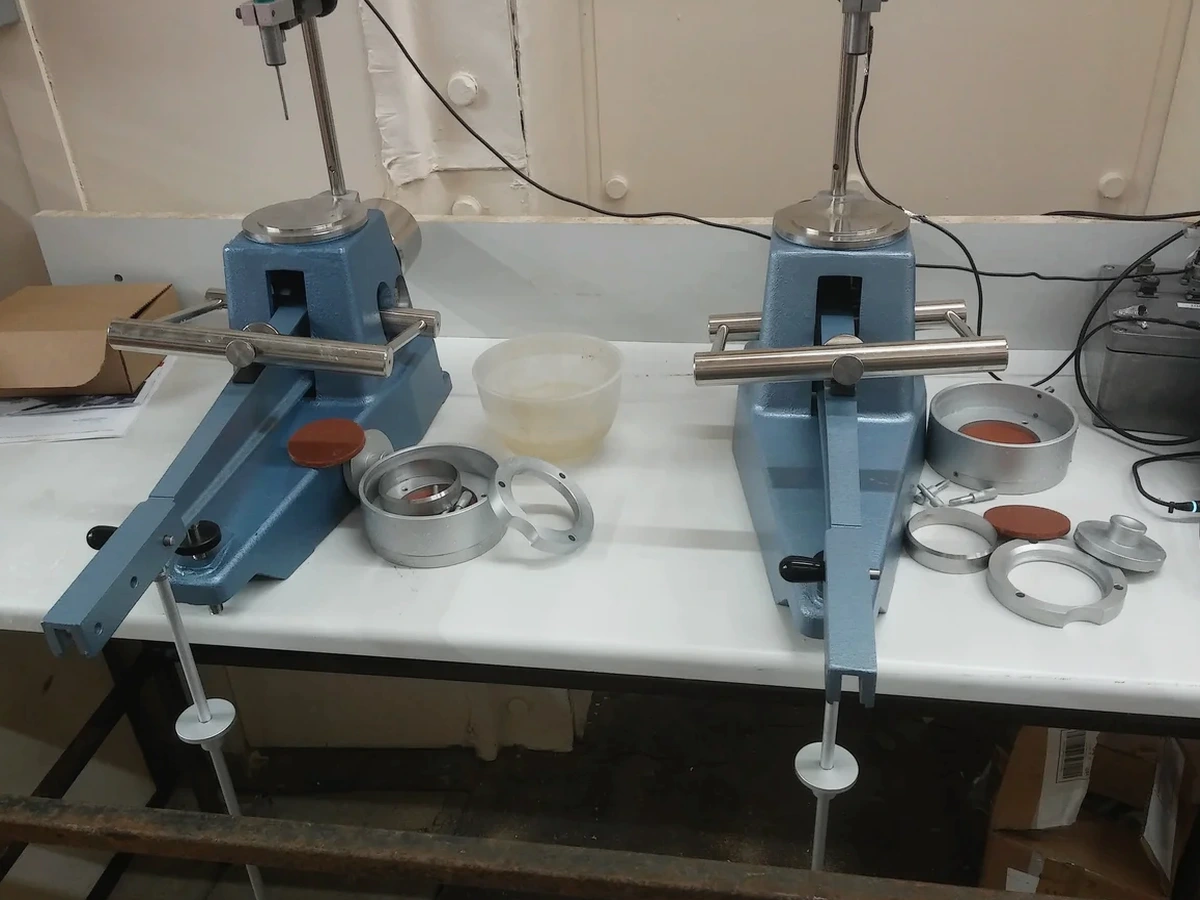
The single most costly mistake we see in Saguenay is treating the local silty clays like ordinary soil. A contractor breaks ground in Jonquière, finds grey material that holds a slope for a few days, and assumes standard bearing values. Then the first heavy rain hits, the clay absorbs water, and suddenly the excavation walls start creeping. That grey material is likely part of the Laflamme Sea post-glacial deposit — a sensitive marine clay whose behavior changes dramatically with water content. Without Atterberg limits testing, you are guessing at the most basic property that controls everything: where the soil transitions from solid to plastic to liquid. Our laboratory in the region runs these tests per ASTM D4318 on samples from Chicoutimi, La Baie, and the entire Saguenay corridor, delivering classification data that structural and geotechnical engineers can actually use for foundation design.
In Saguenay's post-glacial clays, the plasticity index is often the single most predictive number for both short-term constructability and long-term foundation performance.
Area-specific notes
The National Building Code of Canada (NBCC 2015) classifies much of Saguenay as having sensitive fine-grained soils, and CSA A23.3 references Atterberg limits as a basic requirement for determining foundation bearing resistance. The risk specific to this region is the presence of quick clays — soils that can lose nearly all shear strength when remolded, turning from a solid into a liquid-like slurry. This phenomenon is well documented in the Saguenay–Lac-Saint-Jean lowlands and was a factor in the 1971 Saint-Jean-Vianney landslide, one of Canada's most catastrophic quick-clay events. A liquidity index near or above 1.0 in an Atterberg test result is a clear signal that the soil is close to remolding instability, and any excavation or fill placement must account for that fragility. Ignoring these indices is not a minor oversight; in this geological context, it is a direct safety risk to workers and future occupants. The Atterberg limits provide the first quantitative warning of that risk.
Standards used
ASTM D4318-17e1: Standard Test Methods for Liquid Limit, Plastic Limit, and Plasticity Index of Soils, AASHTO T-89 and T-90: Determining the Liquid Limit and Plastic Limit of Soils, NBCC 2015, Division B, Section 4.2: Foundations on sensitive fine-grained soils, CSA A23.3-14: Design of Concrete Structures (foundation references), USCS Classification per ASTM D2487
Quick answers
What do the Atterberg limits actually tell me about my Saguenay site?
They define the water contents at which the soil changes behavior. The liquid limit marks the boundary between liquid and plastic states, the plastic limit marks the boundary between plastic and semi-solid states, and the plasticity index (LL minus PL) tells you the range of water content over which the soil behaves plastically. In Saguenay, a high PI typically indicates a clay with significant volume change potential and sensitivity to moisture, which directly impacts footing design and excavation stability.
How much does Atterberg limits testing cost in Saguenay?
For a standard suite including liquid limit, plastic limit, and plasticity index on one sample, you can expect a range of CA$100 to CA$140, depending on sample preparation requirements and turnaround time. Multi-sample or rush projects are priced accordingly.
How long does it take to get results back?
Standard turnaround is 5 to 7 business days from sample receipt. The drying, grinding, and equilibration steps cannot be rushed without affecting accuracy. We can accommodate 48-hour rush processing for an additional fee when project schedules demand it.
Why can't I just use a pocket penetrometer or field vane instead?
Field tools give you a quick index of consistency, but they do not tell you the Atterberg limits. You cannot determine liquid limit or plasticity index from a penetrometer reading, and without those numbers you cannot classify the soil per USCS or estimate its engineering behavior. In Saguenay's sensitive clays, field indices can be dangerously misleading if the soil is close to its liquid limit.
Do Atterberg limits change over time after construction?
The intrinsic Atterberg limits of a mineral soil do not change. However, the in-situ water content can fluctuate due to seasonal moisture, broken drainage, or vegetation changes. That is why we always pair Atterberg tests with natural water content — the relationship between current water content and the Atterberg limits (the liquidity index) tells you whether the soil is likely to experience volume change or strength loss under future conditions.