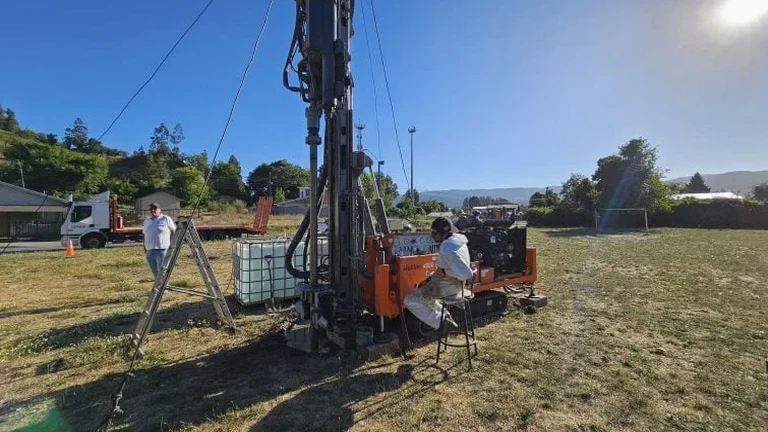
A 20-ton excavator with a 24-inch smooth bucket cuts through the stiff silty crust of the Saguenay lowlands, opening a window into the subsurface that no borehole can match. Exploratory test pit investigation in this region means direct visual access to the complex layering left behind by the Laflamme Sea incursion, where glaciolacustrine silts sit over sensitive marine clays at depths often exceeding 3 metres. Our field teams log strata in-situ using the Unified Soil Classification System, collect undisturbed block samples from pit walls, and perform pocket penetrometer and torvane readings right at the face. For projects near the Rivière Saguenay or on the terraces above Jonquière, the test pit method reveals sand lenses, oxidized zones, and groundwater seepage patterns that drive critical decisions on footing elevation and drainage design.
A single test pit in Saguenay's marine clay can reveal the difference between a conventional footing and a piled solution, all before a single structural dollar is spent.
Area-specific notes
The marine clay deposits underlying much of Saguenay, deposited during the post-glacial Laflamme Sea transgression, carry a well-documented sensitivity that can exceed 30, meaning the undisturbed strength collapses upon remolding. Excavating a test pit through the weathered crust into this intact sensitive clay without triggering a bottom heave or sidewall instability requires staging the cut and managing water inflow carefully. In the Kénogami and Arvida sectors, buried boulder-strewn till layers intermix with varved silts, creating abrupt stratigraphic contrasts that are easily missed in a borehole log but plainly visible on a properly cleaned pit wall. Our crews include a supervising engineer who inspects each pit face before sampling, checking for shear surfaces, organic seams, and desiccation cracks that signal seasonal groundwater fluctuation and potential long-term settlement under load.
Quick answers
What is the typical cost of an exploratory test pit in Saguenay?
For a standard investigation involving machine excavation to 3–4 metres depth, logging by a field engineer, and collection of disturbed samples, budget between CA$750 and CA$1,000 per pit. The price varies with access conditions, the number of pits, and whether undisturbed block sampling or groundwater monitoring is required.
How long does a test pit investigation take, from mobilization to final report?
Fieldwork for two to four pits is typically completed in one day, provided utility locates are cleared in advance. The geotechnical report with logs, field test results, and foundation recommendations is delivered within five to seven business days after the site work.
Can a test pit replace a borehole for foundation design in Saguenay?
A test pit provides higher-quality visual and sampling data within the reach of the excavator, but it cannot go as deep as a borehole. For single-family homes and light commercial buildings founded within 2–3 metres of grade, a test pit program is often sufficient. When deeper strata control the design, we recommend supplementing with CPT soundings or SPT boreholes.
What safety measures are followed during test pit excavation in sensitive clay?
All excavations in Saguenay's sensitive marine clay are benched or sloped back at a ratio no steeper than 1.5H:1V, and the pit is inspected by the supervising engineer before anyone enters. Groundwater is controlled with sump pumping where necessary, and the spoil is placed at least 1 metre from the edge.